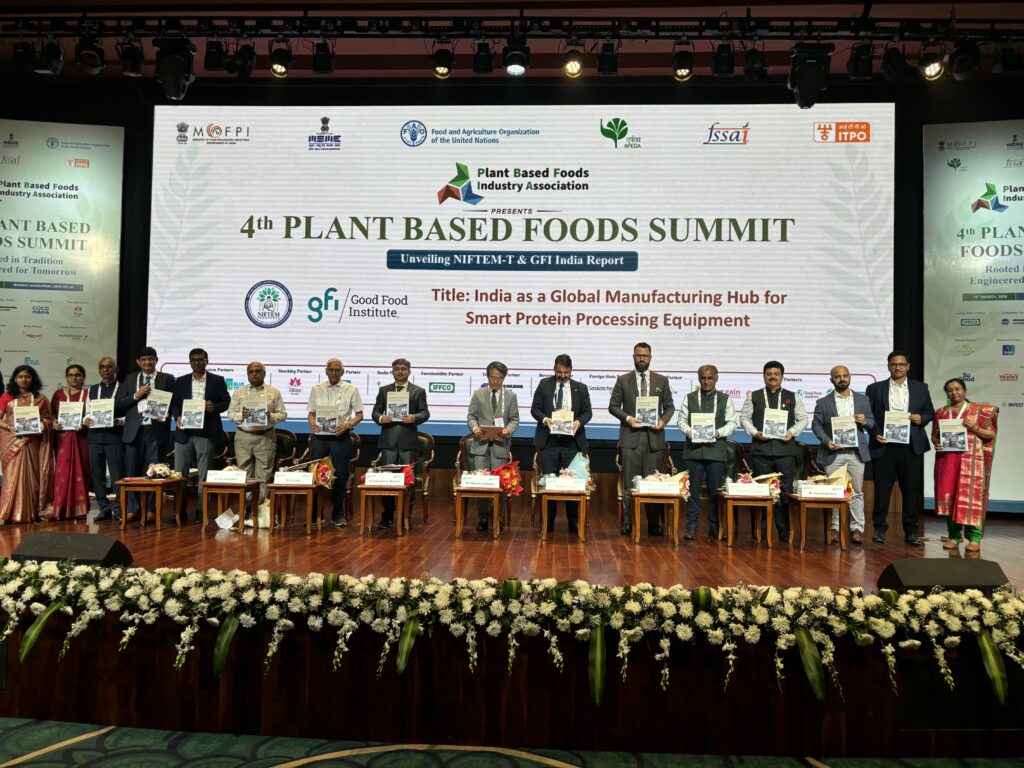

Smart protein equipment manufacturing hub initiative
A joint report by NIFTEM-T and GFI India on key insights and strategic recommendations to build India’s self-reliant smart protein equipment ecosystem

Background
India is at a strategic inflection point to emerge as a global manufacturing hub for smart protein processing equipment. As demand for plant protein isolates and plant-based alternatives grows, so will the need for specialised processing systems, such as extruders, dryers, and separators. This report examines India’s current capabilities, major technology and supply-chain gaps, and the actions needed to reduce import dependence, strengthen industrial competitiveness, and position the country as a globally relevant supplier of next-generation food-processing machinery.
Why this matters now
India already has a strong manufacturing base to build on, with an estimated 150-200 OEMs serving the food, dairy, chemicals, plastics, and allied sectors. At the same time, high-performance systems and critical subsystems for smart protein processing remain heavily import-dependent. The report shows that unlocking this opportunity will require targeted action on precision manufacturing, validation infrastructure, standards, localisation, R&D, and service ecosystems.
Key findings
India has meaningful domestic capability in standard and mid-scale equipment, but gaps remain in precision fabrication, advanced automation and control systems, hygienic design, food-grade critical components, and testing and certification infrastructure.
- In extruders, imports continue to dominate high-performance applications, with 60 to 70 percent of control electronics still imported.
- In dryers, domestic manufacturing is strong in spray and fluidised-bed systems, but large-scale freeze-drying remains dependent on imported subsystems, including critical compressors.
- In separators, advanced ultrafiltration and microfiltration systems remain heavily import-dependent, with no established indigenous manufacturing base for food-grade membranes.
Recommendations
Supporting technological progress and domestic manufacturing
- Co-funding shared precision facilities in existing clusters (advanced CNC time, rotor balancing, metrology, surface finishing, and control system test benches) on a pay-per-use model to help MSMEs/OEMs build repeatable, higher-performance machines.
- Creating a national platform where OEMs publish verified requirements (technical details, qualification tests, annual volumes) and MSMEs bid to turn localisation into a trackable vendor-development pipeline that reduces search/transaction costs.
- Setting up dedicated food machinery clusters inspired by Tumkuru Machine Tool Park (TMTP), with strong state government leadership and JV partnerships where feasible—targeting subsystems that materially affect cost, lead time, and uptime.
- Accelerating access to proven subsystem technologies through licensing and co-development tied to India-specific cost/performance targets, supported by time-bound incentives linked to localisation milestones and validated improvements.
- Standardising non-differentiating elements (material grades, surface finish, seals/valves, fasteners, control cabinet architecture, documentation templates) and shared supplier audit protocols to increase interchangeability and make supplier investment viable.
- Setting up a high-powered committee (academia, ministries, private sector) to diagnose India’s declining performance in this capital goods category and recommend a pathway to strengthen India’s position in food processing machinery.
Fostering R&D and creating pathways for industry-academia collaboration
- Making food equipment eligible for RDI support to help firms develop product lines meeting international standards, with targeted R&D across extrusion, drying integration, separation/filtration, materials/wear parts, and digital controls/diagnostics.
- Supporting pre-competitive collaboration through shared pilots, shared test data, and jointly defined benchmarks to reduce duplication and accelerate learning in emerging, high-uncertainty subsystems.
- Using demand-driven capital goods schemes to create Centres of Excellence (CoEs) focused on advanced food processing machinery (an identified gap in current CoEs), strengthening applied work in hygienic engineering, sensors, control systems, and integration.
Study partner
This report was prepared by the National Institute of Food Technology, Entrepreneurship and Management, Thanjavur (NIFTEM-T) and supported by GFI India. NIFTEM-T, an Institute of National Importance under the Ministry of Food Processing Industries, brings premier research and academic capabilities in food technology, while GFI India contributes sector expertise across science, policy, and industry to help accelerate India’s smart protein ecosystem.